How RedCare and Intersport Lifted Google Shopping CTR by up to 25% with Their Own CSS
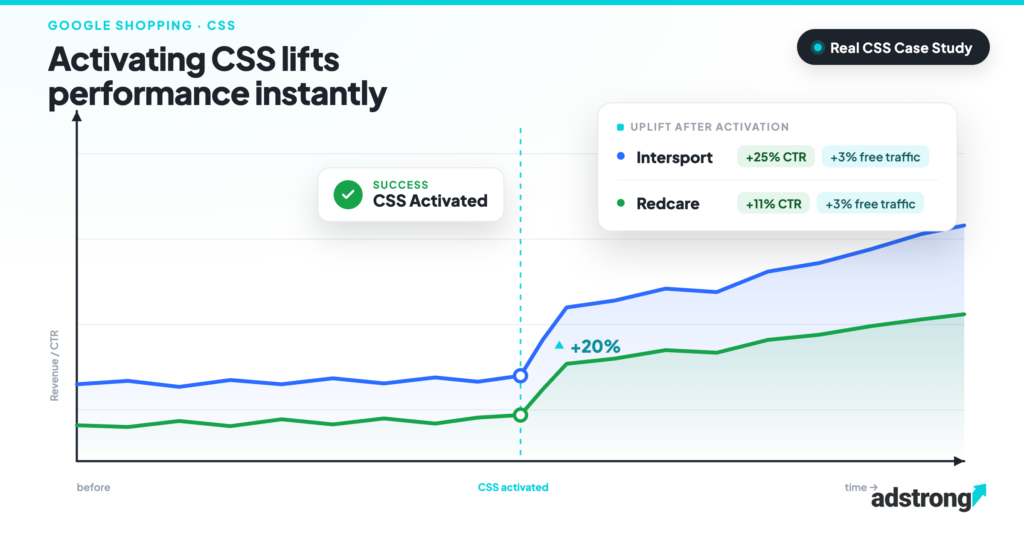
By moving from a conventional third-party CSS to their own Keyword CSS, RedCare and Intersport lifted Google Shopping CTR by 11% and over 25% respectively — with no considerable changes to their campaigns — and recaptured roughly 3% of ad traffic as free clicks. The setup was run by adstrong, the Google CSS Premium Partner managing over 20% of all Google CSS Centers worldwide.
Most advertisers treat their Comparison Shopping Service as a solved problem: pick a third-party provider, collect the CPC advantage, move on. This CSS case study shows what that mindset leaves on the table.
The CSS case study results at a glance
| Result | Client | Setup |
|---|---|---|
| +25% CTR | Intersport | Own Keyword CSS vs conventional CSS |
| +11% CTR | RedCare | Own Keyword CSS vs conventional CSS |
| ~3% additional free traffic | Both | Free CSS-link clicks recaptured from competitors |
| Click rate 5% → 17% | Across measured clients | Conventional adstrong CSS → Keyword CSS |
All measured against a conventional third-party CSS setup, with no considerable changes made to the campaigns.
The challenge: a third-party CSS is no longer an advantage
Every advertiser running Shopping ads in Europe uses a CSS — either one they chose, or Google Shopping Europe, the default that deducts a 20% margin from every bid before it enters the auction. Switching to a third-party CSS eliminates that waste, and until around 2020–2021 that alone was a competitive edge.
Today it’s the base case. When most of your competitors have the same CPC advantage, a third-party CSS isn’t playing to win — it’s playing not to lose. That was the position RedCare and Intersport were in: solid campaigns, a conventional CSS, and no relative advantage left in the setup.
There was a second, less visible problem. In every Shopping ad, the CSS provider’s name is displayed at the bottom in a highlighted blue link — more prominent than the shop’s own name. Clicks on that link are free and lead to the CSS provider’s comparison site, where large providers monetize the traffic by selling it on, typically to competitors. In other words: the shop pays for the ad, manages the campaign, and a third party’s brand collects the visibility and the free traffic.
The solution: an own Keyword CSS
adstrong moved the Merchant Centers advertising RedCare and Intersport out of a conventional CSS and into their own Keyword CSS — a turnkey setup where adstrong handles the application, the Google-compliant price comparison portal, and ongoing operation, while the shop owns the CSS and its benefits. Two mechanisms drive the results:
1. Relevance in the ad itself
Instead of an irrelevant provider name, the “By …” link now carries a keyword matching the user’s search intent. Higher relevance means higher CTR; higher CTR means a better quality score; a better quality score means lower CPCs. The effect is measurable even against strong baselines: when the Converse brand CSS was changed to a “Sneakers” Keyword CSS, performance improved further — and Intersport, which had already gained 25% CTR by moving to its brand CSS, added another 2% incremental gain from the Keyword CSS.
2. The Free Clicks Booster
Free clicks on the CSS link no longer leak to competitors. adstrong’s Free Clicks Booster routes all of that traffic to CSS landing pages showing only the shop’s own products — localized for 21 CSS countries, in the client’s branding, with zero work on the client’s side.
Three percent free traffic may sound modest — until you scale it against what large shops spend on Google Shopping. For advertisers at this level, it adds up to five- or six-figure sums every year.
It works for agencies too
For agencies, an own CSS works as a strategic asset rather than a performance lever. Every client ad displays the agency’s brand in the prominent CSS link — millions to billions of free brand impressions, depending on managed ad spend, at no extra cost or work. The agency Touchpoint runs its clients’ Shopping ads under “By Touchpoint CSS,” with the free-click traffic landing on Touchpoint-branded pages showing only its clients’ products.
“Our own CSS has created an effective win-win situation for our customers and dreifive. Our customers get the best possible Google Shopping performance and the best possible support for all topics related to Shopping ads. dreifive can in turn offer everything from a single source, constantly receives new customer inquiries through the CSS, and can better assert itself on the market with the expert status it has gained.”
— Pascal Schumacher, Head of Digital Advertising, dreifive
On top of visibility, CSS providers unlock exclusive Google support resources — feed translation, audit and implementation services, negative keyword management for PMax at campaign level — and can qualify for Google CSS Partner or Premium Partner status, including the badge and a listing in Google’s CSS partner directory. The full agency model is covered in our Branded CSS solution.
Key takeaways
- Stop thinking about a CSS purely in terms of the CPC boost. That debate is over — and it’s table stakes anyway.
- An own CSS is a strategic asset: ad relevance, free traffic recaptured from competitors, branding, and exclusive Google support resources.
- Owning a CSS used to mean running your own compliant price comparison portal. With a turnkey solution, any shop or agency can now own one — with zero work on their side.
Who is it for? The Keyword CSS is recommended for larger online shops — from a five-digit monthly ad spend, or wherever a shop wants to own a specific keyword in its category. The agency CSS is the best fit for agencies and most of their clients.
Frequently Asked Questions
What is an “own CSS”?
A Comparison Shopping Service registered in the shop’s or agency’s own name, operated turnkey by a provider like adstrong. The owner’s brand appears in the “By …” link on every Shopping ad, and the free clicks on that link land on the owner’s own comparison pages.
How much does CTR improve with a Keyword CSS?
In adstrong’s measured client base, moving from a conventional CSS to a Keyword CSS lifted CTR by 11% (RedCare) to over 25% (Intersport), with click rates on the CSS link rising from 5% to 17% — without significant campaign changes.
Where do the free CSS clicks normally go?
To the CSS provider’s comparison site, where large providers typically monetize the traffic by selling it on — often to competitors. With an own CSS, those clicks land on pages showing only the owner’s products.
Do campaigns need to be rebuilt for an own CSS?
No. The switch happens at Merchant Center level; campaigns, bids and feed stay unchanged. The results in this case study were measured with no considerable changes to the campaigns.
Who should consider an own CSS?
Shops from a five-digit monthly Google Shopping spend, brands that want to own a category keyword, and agencies of any size — for agencies the own CSS doubles as a branding and lead-generation asset.
Want to know what your own CSS could deliver?
We’ll quantify the benefits you can expect from your own setup.

David Klein
David Klein is Chief Marketing Officer at adstrong, the Google CSS Premium Partner powering Google Shopping and programmatic growth for merchants and agencies across Europe. He drives brand, positioning and growth marketing for the company. Meet the team
