Is a Google CSS Actually Worth It? The Cost/Benefit Analysis
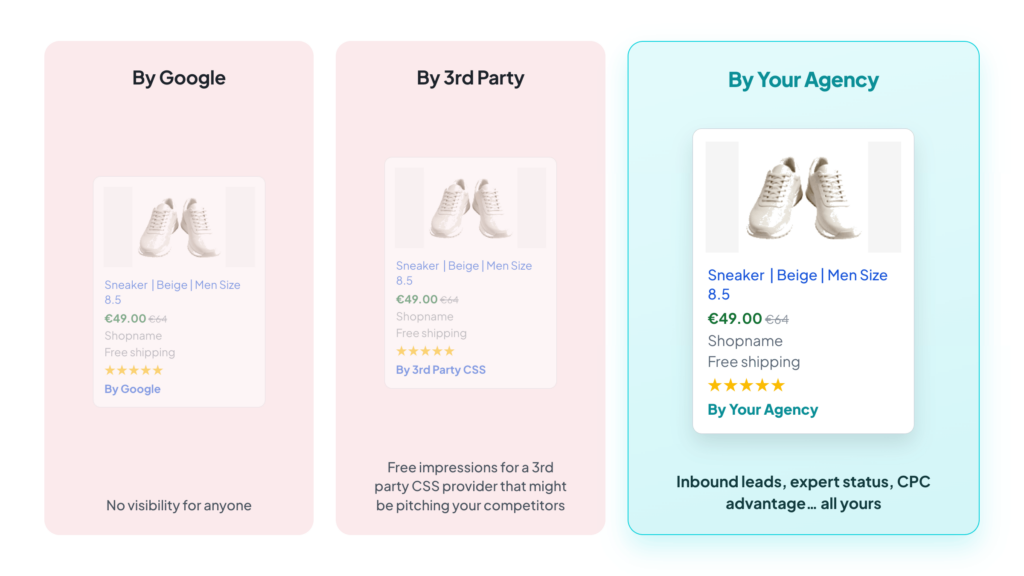
Is a CSS worth it? For most shops running Shopping ads in Europe, yes: your bids enter the ad auction at 100% of their value, while bids placed through Google’s own CSS compete with up to 20% deducted. That structural advantage usually outweighs the partner fee by a wide margin. adstrong, a Google CSS Premium Partner, applies it across 20,000+ Merchant Centers, over 20% of all Google CSS Centers worldwide.
But “usually” is not “always”. This page walks through the actual math: what the advantage is, what a CSS costs, when it pays off, and the cases where it genuinely doesn’t.
Table of contents
- Key facts
- How does the CSS advantage actually work?
- Does a CSS really save 20%?
- What does a CSS cost?
- When is a CSS worth it?
- When is a CSS not worth it?
- How do you measure the impact?
- Google’s own CSS vs a CSS partner
- Frequently Asked Questions
Key facts
| Question | Answer |
|---|---|
| What is the advantage? | Bids via a CSS partner enter the auction at 100%; via Google’s own CSS at ~80% |
| Is it a discount on your bill? | No, it is bidding power. You see it as more traffic at equal bids, or equal traffic at lower CPCs |
| Where does it apply? | All CSS-enabled countries: EEA, UK, Switzerland (soon, even more new countries) |
| Does it work with Performance Max? | Yes, the advantage applies to Shopping inventory in PMax |
| Campaign changes needed? | None, one Merchant Center switch, no downtime |
| Typical setup time | Days |
How does the CSS advantage actually work?
Every Shopping ad in Europe runs through a Comparison Shopping Service. When you advertise through Google’s own CSS (Google Shopping), Google deducts a 20% margin from your bid before it enters the auction: a €1.00 bid competes as €0.80. When you advertise through an independent CSS partner, no margin is deducted, your full bid competes.
| Your max CPC bid | Effective bid via Google’s own CSS | Effective bid via a CSS partner |
|---|---|---|
| €1.00 | €0.80 | €1.00 |
| €0.80 | €0.64 | €0.80 |
Read that table the other way round and you see the competitive reality: an advertiser on Google’s own CSS must bid €1.25 to match your €1.00 placed through a partner, up to 25% more, for the same auction position.
What about adstrong? adstrong is a Google CSS Premium Partner, the highest tier in the program, and passes the full bidding advantage through on every account: 20,000+ Merchant Centers, zero CSS-related suspensions since 2018, no changes to your campaigns required.
Does a CSS really save 20%?
Not as a line item, and any provider that promises a literal 20% discount on your invoice is overselling. The 20% is auction mechanics, not a rebate. What you actually observe after switching is one of two effects, depending on how you use the advantage:
- Same bids → more volume. Your ads win more auctions, so impressions and clicks rise. The extra traffic often comes from broader queries, so expect a somewhat lower conversion rate on the increment.
- Lower bids → same volume. Reduce bids (or raise your ROAS target) by 10–20% and keep roughly the same traffic at a lower average CPC. This is the cleaner way to bank the advantage as profit.
With automated bidding (Target ROAS/CPA), the algorithm absorbs the advantage for you: unchanged targets typically yield more conversions; tightened targets yield the same conversions for less spend.
What does a CSS cost?
The Google-side advantage is identical for every CSS partner. What differs is the business model, and that is where the cost/benefit math is won or lost:
| Model | How you pay | Watch out for |
|---|---|---|
| Fixed monthly fee | Flat fee per shop/country; you keep full control of campaigns | Predictable: the model the math below assumes |
| CPC / revenue share | The CSS runs its own campaigns and charges per click or per sale | Their campaigns can compete with yours; costs scale with volume |
| Performance / affiliate | Compensation only on results | Good for incremental traffic; not a replacement for your own campaigns |
adstrong publishes current fees for every model on its pricing page, fixed fees for Keyword CSS and CPC Boost, and a performance model for Affiliate CSS.
When is a CSS worth it?
The break-even logic is simple: the advantage scales with your Shopping spend, the fee doesn’t. Treat 20% of monthly Shopping spend as the theoretical ceiling of the benefit (real, measured effects vary by account and competition, see the measurement section):
| Monthly Shopping spend | Theoretical benefit ceiling (20%) | Against a low fixed monthly fee… |
|---|---|---|
| €500 | up to €100 | Usually already worth it |
| €2,000 | up to €400 | Clearly worth it |
| €10,000 | up to €2,000 | Not switching is the expensive choice |
Even at a fraction of the ceiling, a fixed-fee CSS typically pays for itself from low three-figure monthly Shopping budgets upward.
When is a CSS not worth it?
Honest answer: there are real cases:
- You advertise outside the CSS countries. The program covers 21 European markets. Shopping ads in the US, Australia or elsewhere gain nothing.
- Your Shopping spend is negligible. Below roughly €100/month, even a small fixed fee can eat the benefit.
- You are locked into a CPC-share CSS whose campaigns compete with yours. Switching model first, provider second.
- You sell only on marketplaces without your own Merchant Center, there is nothing to switch.
How do you measure the impact?
The clean test: switch your existing Merchant Center (keeping campaigns, bids and targeting identical), then compare 2–4 weeks before vs after on three numbers: impressions, clicks, and average CPC. Expect visible movement within days, statistically solid reads after two weeks.
Google’s own CSS vs a CSS partner
| Google’s own CSS | CSS partner (e.g. adstrong) | |
|---|---|---|
| Share of bid entering the auction | 80% | 100% |
| Cost | No fee (margin is taken in the auction) | Fee, model-dependent |
| Campaign control | Yours | Yours (with a self-service partner) |
| Campaign changes on switch | – | None |
| “By …” label on your ads | By Google | By [CSS name] |
| Support | Google standard | Partner + Google (with a Premium Partner) |
Frequently Asked Questions
Is a Google CSS worth it?
For most shops advertising on Google Shopping in all the CSS countries, yes: bids through a CSS partner enter the auction at full value instead of 80%, and the benefit scales with spend while fees stay flat. It is typically not worth it outside Europe or with negligible Shopping budgets.
Does a CSS really save 20%?
Not as a discount on your bill. The 20% is auction mechanics: your full bid competes, while bids via Google’s own CSS compete at 80%. In practice you see more traffic at equal bids, or equal traffic at 10–20% lower CPCs.
Will I see the CSS advantage in my Google Ads account?
There is no “discount” line in Google Ads. The effect shows up in performance metrics after switching: higher impression share and click volume at unchanged bids, or stable volume at a lower average CPC.
Does the CSS advantage work with Performance Max?
Yes. The advantage applies to Shopping inventory inside Performance Max. With Target ROAS/CPA bidding, unchanged targets typically deliver more conversions; tightened targets deliver the same results at lower cost.
How quickly do I see results after switching?
The switch itself takes days and requires no campaign changes or downtime. Performance effects are usually visible within days, with a statistically reliable before/after comparison possible after about two weeks.
Can I switch back to Google’s own CSS?
Yes. A Merchant Center can be reassigned at any time. With a fixed-fee, self-service CSS partner like adstrong there is no technical lock-in: campaigns, feed, and account history stay yours.
Run the math on your own numbers.

Vincenzo Ferrera
Vincenzo Ferrera is Head of Sales at adstrong, the Google CSS Premium Partner powering Google Shopping and programmatic growth for merchants and agencies across Europe. He works closely with merchants and agency partners to find the right Google Shopping setup for their business. Meet the team
'/%3E%3C/svg%3E)